Leopard Hunting – Everything You Need to Know

Leopard Hunting in Namibia – Areas, How It Works, Costs

Our best areas for leopard hunting in Namibia

Sustainability, conservation and reality on the ground

Sustainable leopard hunting in Namibia

First, a fair question: why does leopard hunting still exist in Namibia today – and what role does it play in modern conservation strategies for this fascinating species?

The leopard is one of Africa’s most efficient and adaptable predators. Shy, intelligent and perfectly camouflaged, it moves through its habitat mostly unseen. Encounters are rare – often only trail cameras reveal its behavior. At the same time it is a central part of a functioning ecosystem and contributes greatly to the natural balance.

But this balance is under pressure. In Namibia, leopards increasingly share their habitat with people. Especially on farmland, conflicts arise regularly when predators kill livestock. For many farmers this means significant financial losses.

At the same time, Namibia has a special model for living with wildlife: large unfenced areas, a low population density and an approach that balances land use with wildlife protection. Conserving wildlife here is not only an ecological goal, but also an economic one.

This is where controlled, strictly regulated leopard hunting comes in. Instead of fighting leopards uncontrolled, a science-based quota system allows the limited use of individual animals – old males past their prime. The income offsets losses and creates an incentive to keep leopards on the land. Namibia issues only about 250 leopard licenses a year.

The result is an approach that combines two key challenges:
protecting an iconic predator and the economic reality of the people who live with it.

Legal framework

Leopard hunting in Namibia is subject to strict laws and international regulations.

  • Limited quotas per year and per hunting area
  • Permits and documentation required for every animal
  • Regulated by the international CITES convention
  • Contributes to the protection of wildlife and habitats
  • For U.S. hunters: importing a leopard requires a U.S. Fish & Wildlife Service import permit (Form 3-200-19). Apply well before your hunt – we will help you prepare.
Recommended length of a leopard hunt

Because of the effort and intensive preparation involved, we recommend:

  • At least 12 hunting days
  • Ideal: 12–14 days
Cost of a leopard hunt in Namibia

The price has two parts: hunting days & trophy fee

Depending on the area, a leopard hunt costs

  • approx. €9,000 – €11,000 for the hunt itself
  • €8,000 – €11,000 trophy fee if successful
  • a total of up to €22,000
A free-range
hunt

Leopard hunting is one of the most demanding hunts there is. Like all our hunts – in line with the TheEcoHunter criteria – it takes place only in areas without game-proof fences, so the game moves freely across farm boundaries. That is why there is no guarantee of success. It is a true free-range hunt, and we hunt only old males past their prime.

Professional preparation, high success rates from previous leopard hunts and the experience of specialized professional hunters create the best possible conditions.

Our best areas for leopard hunting

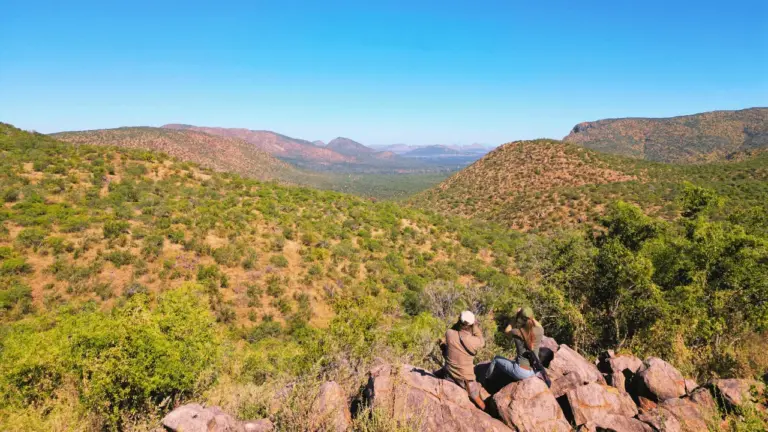
Khomas Highland · 1 hr from airport

Haris

The Garbade family

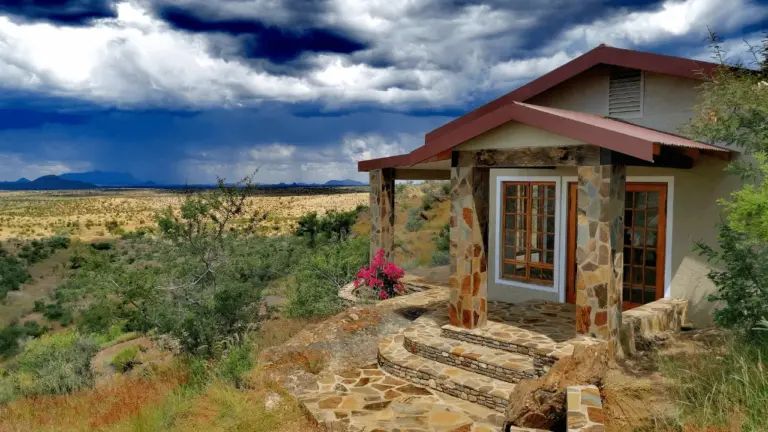
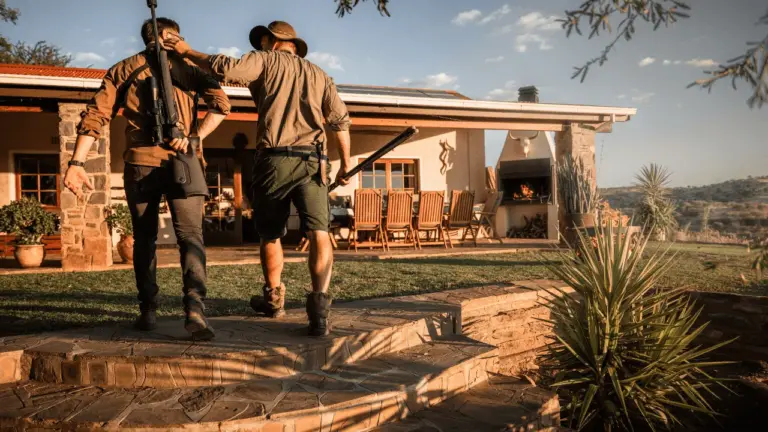
  • Free-standing chalets with panoramic views
  • Horseback safaris, activities for companions
  • Only 1 hr from the airport

Game: Kudu, Oryx, Eland, Hartebeest, Springbok, Warthog, Mountain Zebra, Steenbok, Duiker, Giraffe, Waterbuck (not native, free-ranging remnant population), Leopard, Hyena, Baboon, Jackal
  • Upscale
  • Horseback riding
  • up to 12 guests, max. 6 hunters

Khomas Highland · 2 hrs from airport

Onduno

The Garbade family

  • Very comfortable farmhouse, outstanding food
  • Pool and riding horses
  • Up to 12 guests, max. 6 hunters

Game: Kudu, Oryx, Eland, Hartebeest, Springbok, Warthog, Mountain Zebra, Blue Wildebeest, Steenbok, Duiker, Klipspringer, Giraffe, Leopard, Hyena, Baboon, Jackal

  • Upscale
  • Pool
  • Horseback riding
  • up to 12 guests, max. 6 hunters

Erongo · 2.5 hrs from airport

Okondura

The Liedtke family

  • Excellent kudu country
  • Guest farm with pool, bowhunting possible
  • Up to 12 guests

Game: Kudu, Oryx, Springbok, Mountain Zebra, Impala, Blue Wildebeest, Steenbok, Duiker, Klipspringer, Dik-Dik, Giraffe, Leopard, Hyena, Baboon, Jackal

  • Rustic & cozy
  • Pool
  • up to 12 guests

How a leopard hunt works

Leopard hunting is one of Africa’s most demanding hunts and requires intensive preparation, experience and patience. Because leopards are mainly nocturnal, the hunt takes place mostly at dawn and dusk.

Preparation (weeks to months before you arrive)

Intensive preparation in the hunting area starts long before you arrive. Several bait sites are set up in strategic places that match the leopards’ natural movement patterns. They are checked regularly to detect activity early and confirm that baits are being taken.

Monitoring & careful selection

During the hunt, all bait sites are monitored systematically. Trail cameras, tracks and fresh kills help identify active leopards. The goal is to confirm a suitable, old tom and focus the hunt on him.

Hunting from a blind or at a fresh kill

Once a leopard regularly visits a bait, the decisive phase begins. The blind is set up in the best position, with safety and a clear shooting lane as top priorities. Because leopards are mainly nocturnal, the hunt takes place mostly at dawn and dusk. Night hunting and hunting with artificial light are prohibited in Namibia. This phase requires absolute silence, patience and concentration – often a single moment decides the outcome.

The shot & follow-up

When the right opportunity comes, the shot is usually taken at close range under controlled conditions to ensure a clean, ethical kill. If necessary, a careful follow-up with experienced trackers follows – this is where experience, caution and professionalism matter most. Afterwards, the legally required photos of the leopard with its permit tag are taken; they are essential for export and documentation.

After the hunt

After a successful hunt, the leopard is properly cared for and prepared for the next steps. The farms also handle all required documents and export formalities, so everything runs smoothly and legally.

Experience & professionalism of our partners

Our hunting farms have many years of experience organizing leopard hunts

  • Licensed professional hunters
  • Decades of experience
  • Transparent costs

This combination ensures a safe, professional and authentic hunting experience.

Reviews of TheEcoHunter

You are currently viewing a placeholder content from TrustIndex. To access the actual content, click the button below. Please note that doing so will share data with third-party providers.

More Information
Reviews of TheEcoHunter
Interested in a leopard hunt?
Fill in the short form – we will get back to you personally with suitable areas, available dates and costs.

You need to load content from reCAPTCHA to submit the form. Please note that doing so will share data with third-party providers.

More Information
partner the eco hunter napha ifn asr zurich ingwe
Any questions?

We look forward to hearing from you.